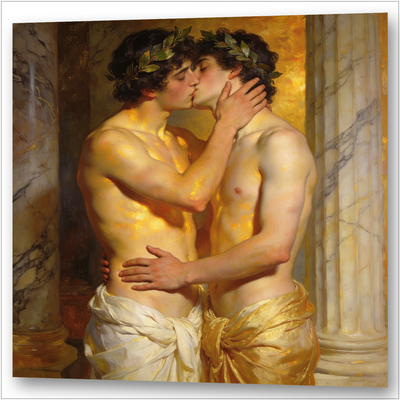
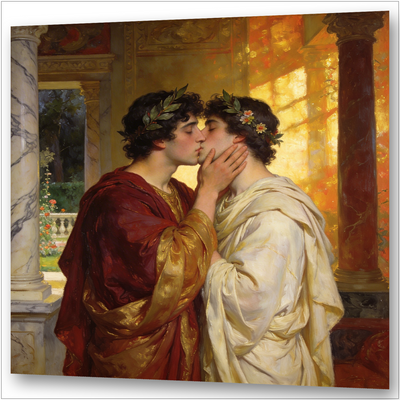
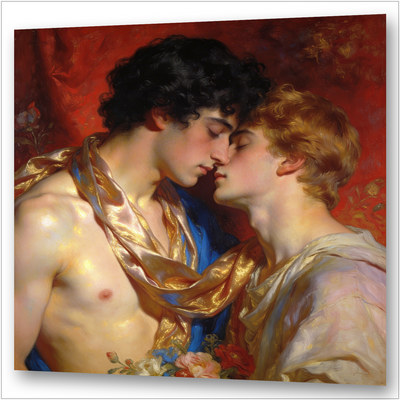
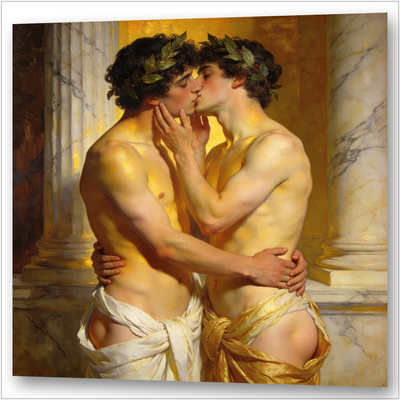
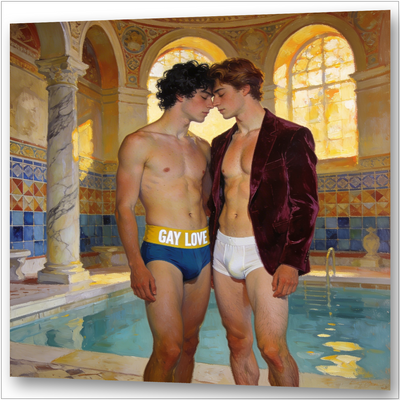
Candlelight on marble. Steam above the water. A young man kneels naked at the edge of the basin, reaching out to his lover waiting in the water. What would have been inconceivable in the era we placed the scene – we take it further. We show what gay men desired and secretly did even then, in "strictly moral" Victorian England.
Transformation as Visual Narrative
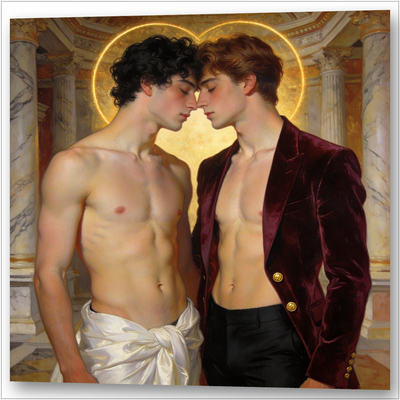
No masquerade, no costume party. A gentle, consistent change: tattoos, modern gestures, a posture belonging to the 21st century – yet dissolving into marble and drapery. The warm, golden light emphasizes the contours of the skin. Fine brushstrokes mark the transition between today and yesterday. The time travel is not explained – it happens to the viewer as they watch.
Desire Between Then and Now
At the center is longing – no theater, no poster. An intimate, almost shy desire. The figures look at each other, react to touches, shy away from eye contact. The ancient bath as a place of purification becomes a vessel for what cannot be washed away: desire. It was there then. It is there today. Clothes, language, and laws change – that does not.
Why the Simeon Solomon Style Is So Effective
Simeon Solomon painted longing between men – hidden in halos and gold, because Victorian England would otherwise have destroyed him. His aesthetic: sensual, melancholic, imbued with ancient myths. In this homage, his visual language is used to honor modern gay men – not to objectify them. Warm ochre and ivory tones, cool aquamarine reflections. Familiar and strange at the same time – just like a journey through time.

Men Traveling Through Time
Modern gay men stepping into another century – that has a dual effect. On the one hand, escape: examining identity conflicts in a different historical context. On the other hand, a clear statement: the present cannot be erased. Tattoos remain. Modern gestures remain. Every historical iconography is filtered through contemporary eyes – and that is not a weakness, but the core of the image.
Details that Carry the Narrative
An outstretched hand reaching for water. A slightly tilted head suggesting closeness. A bracelet between an ancient bowl and modern skin. Such details make the time travel believable – because they are human. They transform historical settings into living spaces. Not a reenactment. A reunion – between times, bodies, and feelings.
What Remains
After viewing, a feeling remains: that desire is constant and identity is fluid. Which parts of one's own present would fade – which would endure?
"Come to me" is not a stylistic quote. It is what Simeon Solomon carried within him and was never allowed to show. This picture shows it.
Gay Art Wall Art. Gay Art for Your Home. KUNSTWERK BILDER.