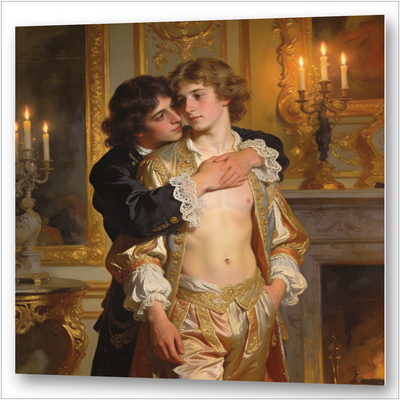
A King Out of Time
His name is Ludwig II. But the world knows him as Neuschwanstein. That's the first problem. A person is reduced to a building – and this building itself hovers between art, kitsch, and Disneyland. Walt Disney copied it, millions photograph it, Bavaria markets it. What gets lost in the process: the man behind it, his love, his loneliness, his mysterious death. Ludwig II of Bavaria was one of the most famous gay men in world history – even if his era had no words or understanding for it. What was dismissed as eccentricity was, in reality, the desperate escape of a man who lived in a world that wouldn't let him be who he was.
The Facts: Who Was Ludwig II?
Ludwig II was born on August 25, 1845, at Nymphenburg Palace near Munich. At 18, he ascended the Bavarian throne – young, handsome, highly intelligent. The populace loved him. The court expected a wife, offspring, and raison d'état from him. What he truly wanted was something else.
His diaries, some of which were destroyed and some kept under wraps after his death, clearly show: Ludwig loved men. He wrote about his feelings with a mixture of longing, shame, and religious torment – typical for a 19th-century man who knew that his nature was socially unacceptable.
Richard Wagner: The Great Obsession
In 1864, shortly after his ascension to the throne, Ludwig summoned the then-indebted and persecuted composer Richard Wagner to Munich. He saved him from bankruptcy, financed his operas, and built him a theater. The relationship was complex: Ludwig revered Wagner with an intensity that went far beyond patronage. His letters to Wagner are ardent, almost erotically charged.
Wagner himself was heterosexual and pragmatically used Ludwig's affection. He took the money, the patronage, the protection – and married Cosima von Bülow. Ludwig, who perceived this as a betrayal, withdrew. Wagner remained his idol, but the personal closeness was broken.
The Engagement: A Show of Desperation
In 1867, Ludwig became engaged to his cousin Sophie Charlotte in Bavaria – the sister of the famous Empress Elisabeth (Sissi). The engagement was a political and social concession, not an act of the heart. Ludwig postponed the wedding date multiple times, wrote Sophie hardly any personal letters, and finally broke off the engagement in 1869. Sophie is said to have been relieved.
Ludwig never married. He never had a public relationship with a woman. What he did have were intense, documented affections for men in his court – stable masters, actors, officers.
Richard Hornig and Josef Kainz: The Men He Loved
Richard Hornig was Ludwig's closest confidant and riding companion for many years. The relationship lasted almost two decades. Hornig was the man Ludwig was closest to – discreet, loyal, present. When Hornig married, Ludwig broke off contact. The pain of this is palpable in his letters.
Josef Kainz was an actor – young, charismatic, talented. Ludwig invited him, financed trips with him, and wrote him enthusiastic letters. Kainz later reported that Ludwig treated him with an intensity that overwhelmed him. This relationship also ended abruptly.
The pattern is clear: Ludwig sought closeness, found it briefly, lost it – and retreated deeper into his castles.
Neuschwanstein: Escape in Stone

Neuschwanstein is not a fairy-tale castle. It is a monument to loneliness. Ludwig began construction in 1869 – the same year he broke off his engagement. The castle sits on a rock, secluded, difficult to access, theatrical. It was never intended as a residence for state receptions. It was Ludwig's private retreat – a world he could control because the real world offered him no control.
The interiors are overwhelming: frescoes from Wagner's operatic worlds, gilded halls, an artificial grotto with colored lights. Ludwig lived here in a self-created parallel world – surrounded by art, myth, and loneliness.
He slept during the day and lived at night. He had meals served as if guests were present – even though he was alone. The court society called him mad. Perhaps he was. Perhaps he was simply a person who had no other choice but to build his own reality.
The Coup d'État: Deposition and Arrest
By 1886, Ludwig's position had become politically untenable. He had accumulated massive debts – for his castles, his art projects, his lifestyle. The Bavarian cabinet wanted to get rid of him. They commissioned psychiatrist Bernhard von Gudden to prepare an assessment.
The assessment declared Ludwig insane – without ever having personally examined him. It was based on testimonies from court officials. On June 10, 1886, Ludwig was arrested at Neuschwanstein Castle and taken to Berg Castle on Lake Starnberg.
Whether his homosexuality was part of the justification is not historically proven – but it was certainly part of the image his enemies painted of him. A king who didn't take a wife, who preferred men, who retreated into castles – that was sufficient proof of abnormality for 19th-century Bavaria.
The Death: A Mystery Still Unsolved Today
On June 13, 1886 – just three days after his arrest – Ludwig II and his psychiatrist Bernhard von Gudden were found dead in Lake Starnberg. Ludwig was 40 years old.
The official version: suicide by drowning. But Ludwig was a good swimmer. The water at the discovery site was only chest-deep. Gudden had strangle marks on his neck and injuries indicating a struggle.
The theories are numerous: murder by political opponents, escape attempt, accident. To this day, Bavaria does not grant full access to the files. The truth about Ludwig's death is officially unresolved – even after 140 years.
The Legacy: From Scandal to Icon
Neuschwanstein is now Germany's most visited castle – and one of the world's most famous tourist attractions. Walt Disney was inspired by it for Cinderella's castle. Millions of people photograph it annually, unaware that it is the monument of a gay man who was broken by his time.
During his lifetime, Ludwig II was pathologized, disempowered, and possibly murdered. After his death, he was glorified as a legend – but the legend consistently omitted his homosexuality. The fairy-tale king could be anything: eccentric, brilliant, tragic. He could not be gay.
That is slowly changing. Historical research today is unambiguous. Ludwig's diaries, his letters, his way of life – they all tell the same story. He was a gay man in a world that had no language and no empathy for it.
What Remains
Ludwig II stands for something that goes far beyond Bavaria and the 19th century: for the price people pay when they are not allowed to be who they are. He paid it with isolation, with the loss of his power, and possibly with his life.
Neuschwanstein is not a fairy tale. It is a testament. And whoever visits it today should know who built it – and why.
Gay Art. Gay art for your home. KUNSTWERK BILDER.