Have you looked in the mirror this morning? For us, the glass on the wall is an absolute given – a quick check to see if our hair is in place, and off we go. Yet, throughout human history, the mirror was anything but commonplace for millennia. It was a magical object, a luxury item, and a powerful symbol that continues to captivate artists and writers to this day.
From Water Surface to Canvas: The Mirror in Art
It all began – as so often – with a myth. Narcissus, the beautiful youth of Greek mythology, falls in love with his own reflection in a spring and perishes because he cannot grasp the image. This is both primal fear and primal fascination: Who am I – and is that really me over there?
In fine art, the mirror quickly became a favorite object because it solved a technical problem: it adds depth to a flat image.
Jan van Eyck perfected this in 1434 in the "Arnolfini Portrait." In a tiny convex mirror in the background, one can see not only the couple from behind but also the artist himself – an early selfie moment, if you will. Later, Diego Velázquez came along with "Las Meninas" and still confuses viewers today: Who is actually being painted here? The mirror in the background shows the royal couple – who should actually be standing where we are now.
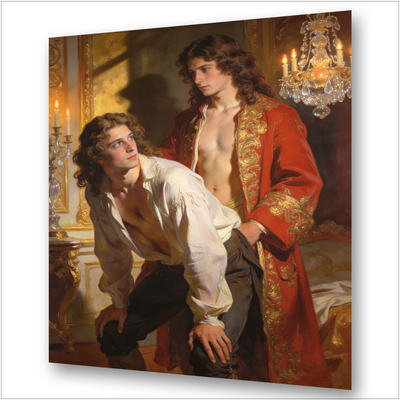
The work raises questions about reality and illusion. This is precisely what inspired our idea, the search for identity in this era, the longing for gay identity; questions posed in the unique setting of the Hall of Mirrors in Versailles.
The Ultimate Flex: The Hall of Mirrors in Versailles
When we talk about mirrors, there's one place we can't ignore: Versailles. If you walk through the Hall of Mirrors today, you might think: chic, but a lot of bling-bling. For the 17th century, this hall was absolutely insane. Mirrors were incredibly expensive and small back then – the technique of producing large, clear glass surfaces was a closely guarded state secret of the Venetians.
Louis XIV, the Sun King, didn't want small hand mirrors. He wanted to demonstrate power. He had Venetian mirror makers smuggled into France – Venice was not amused and is even said to have sent assassins. The hall faces the huge windows overlooking the garden; the incoming light is reflected by 357 mirror surfaces. The result: a room that appears so bright and vast that it seems to confirm the divine order of the Sun King. Anyone who walked through this hall constantly saw themselves in the context of royal splendor. Here, the mirror was not an instrument of self-knowledge – but of intimidation.
The Hall of Mirrors in the Palace of Versailles, we chose precisely this location for our grand artistic experiment. But more on that below.
Between Wonderland and Madness: The Mirror in Literature
In literature, it's less about splendor and more about what lies behind the glass.
Lewis Carroll sent Alice "Through the Looking-Glass" – here, the mirror is the boundary to a world where logic is turned on its head. Grimm's fairy tale features perhaps the most famous mirror in the world: "Mirror, mirror on the wall, who is the fairest of them all?" – the merciless judge who knows no flattery and no mercy.
Oscar Wilde's Dorian Gray is the darkest variant: a young man sells his soul to remain eternally young – while his portrait, his mirrored inner self, becomes increasingly hideous. In Wilde, the mirror doesn't show the face, but the truth behind it. This is not a horror story – it's moral philosophy in oil.
In literature, the mirror is almost always a portal. It separates the self from the other, the real from the fantastic, the visible from the true.
Gay Art in the Hall of Mirrors: What No Painter Ever Conceived
 View the image in the shop
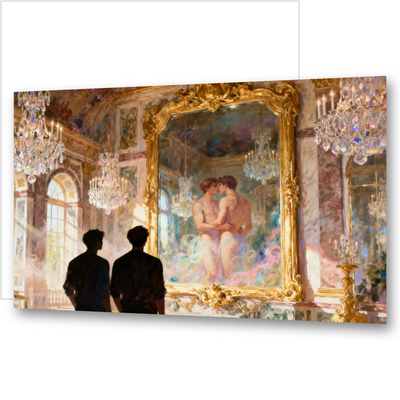
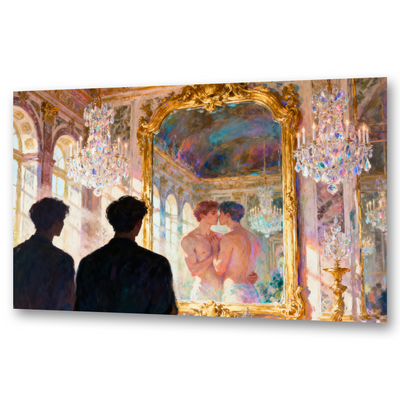
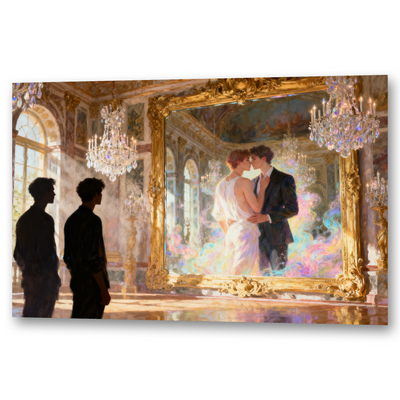
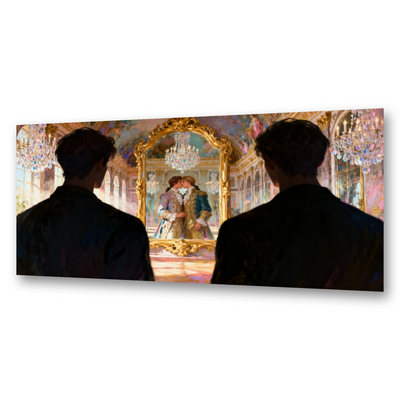
What does the mirror show when two men who love each other look into it? No fairy tale ever asked this question. We asked it – and chose the Hall of Mirrors in Versailles as our stage. And for artistic inspiration, we chose the incomparable style of Claude Monet, the great Impressionist in French art history. No one could better suit our mirrored fairy tale from Versailles.
Claude Monet painted plants, painted his garden – but we bring his art, his style, into the second national sanctuary of the French, next to the Eiffel Tower, into the legendary Hall of Mirrors. What would he have painted there? No one knows. But his style is spot on.
And into this mirror, we've conceived something no painter ever conceived: The mirror doesn't show those standing before it – it shows their love behind it. Naked, kissing, tenderly, naturally. As if the two had stepped into a fairy tale. In love in Paris. Enchanted in Versailles.
Mirror, mirror on the wall – who is the fairest gay couple in all the land?
Gay Art. Gay art for your home. KUNSTWERK BILDER.