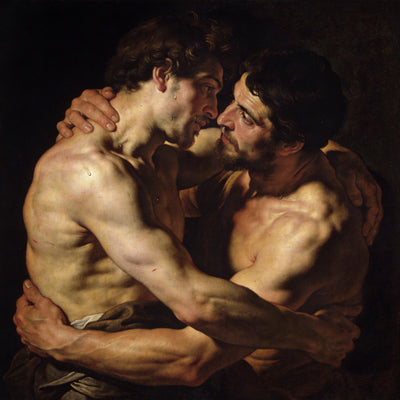
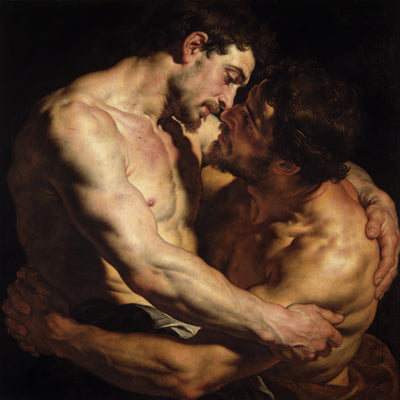
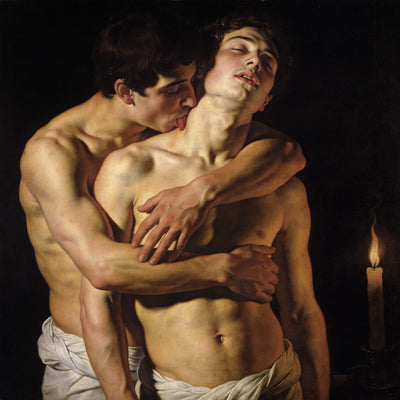
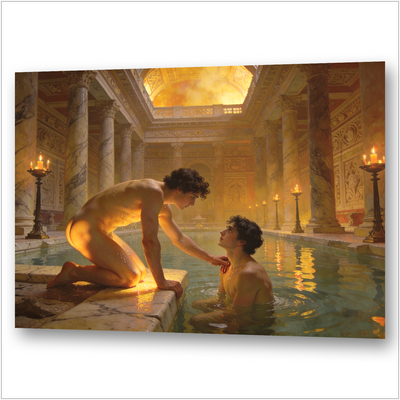
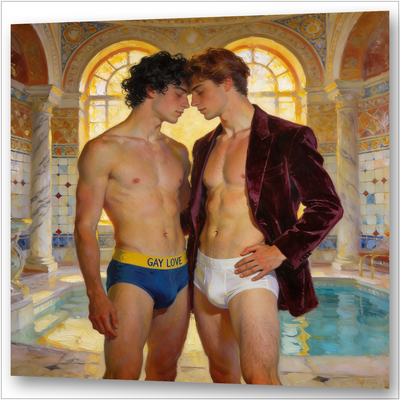
There are painters who depict their time. And there are painters who transcend their time. Michelangelo Merisi da Caravaggio – born 1571 in Milan, died 1610 while fleeing – belongs to the second category. He was a brawler, a drunkard, a manslayer – and the most radical gay painter in art history, who, like so many others in his time, was not allowed to show this. That Caravaggio desired men is historically documented. That art history kept silent about it for centuries is also true. For KUNSTWERK BILDER, he is therefore more than an inspiration – he is a precursor. In religious paintings, approved by the church, he hid what we can openly name today: Gay Art.
Street Boys as Gods
Caravaggio did not paint from his head. He painted what he saw – and what he desired. His models were not idealized academic figures, no smooth gods of marble. They were the boys from Rome's taverns: dirty fingernails, flushed cheeks, bodies that smelled of work and sweat. And it was precisely these bodies that he painted as Bacchus, as John the Baptist, as David.
His Bacchus – the Roman god of wine, intoxication, and dissolution – today exhibited in the Uffizi in Florence – shows a young man with soft shoulders, slightly parted lips, and a gaze that knows no religious devotion. He holds out the wine cup like an invitation. To what exactly, Caravaggio leaves open. But the answer is obvious.
"Men Among Themselves" - The Cardinal's Palace
Caravaggio was gay. This is not a modern interpretation – it is historically documented. His most important patron, Cardinal Francesco Maria del Monte, lived in a palazzo that was extraordinary for its time. He surrounded himself with young musicians, artists, and pages. Contemporary sources describe his household as a place where men were among themselves, wine flowed, and the usual moral rules did not apply. The Church looked away – del Monte was powerful enough. Looking at the goings-on in the Catholic Church today, one could cynically say: It has remained true to this tradition.
Caravaggio lived in the Cardinal's palace from about 1595 to 1600, his most productive early years. His lover from this period, Francesco Boneri, known as Cecco, posed as a nude Cupid in Amor vincit omnia – a painting commissioned by Caravaggio's patron Marchese Vincenzo Giustiniani and hidden behind a green taffeta curtain. It was only shown to selected guests. The art writer Joachim von Sandrart recorded this in the 17th century. It was Giustiniani's most valuable piece – a naked boy triumphing over all the power of the world.
In 1603, Caravaggio's enemy Giovanni Baglione explicitly named him in a court document as someone who desired young men. It is one of the earliest written testimonies of gay sexuality in art history – intended as an insult, preserved as proof.
His Doubting Thomas shows three men crowding around a fourth – Jesus. Fingers reaching into a wound on Jesus' body, where the doubting Thomas seeks proof that the nail of the cross left its mark; so much for religion, but then also faces touching, bodies knowing no distance. It is officially a religious painting. Yet the intensity of this physical closeness, the focus on skin and touch, has little to do with theology. Caravaggio painted desire – and called it faith.
Chiaroscuro as a Queer Technique
 View image in shop
Caravaggio's trademark is chiaroscuro: extreme light against extreme darkness, no gentle transition, no compromise. This technique is not only aesthetic – it is political. It pulls bodies out of the darkness, makes them visible, makes them unmistakable. What remains in the shadows remains unnamed. What stands in the light exists. Who doesn't think of Brecht's Threepenny Opera: Some are in the dark, and others are in the light, and you see those in the light, but those in the dark you do not see.
For Gay Art, this is a perfect metaphor. Visibility as an act. The illuminated body as a statement. Caravaggio never articulated this – but he painted it.
The Murderer Who Painted Saints
In 1606, Caravaggio killed a man in a brawl – possibly over a bet, possibly over something else. He fled Rome, living on the run in Naples, Malta, Sicily. He continued to paint, more brilliantly than ever, driven by guilt and energy. He died at 38, alone, on his way back to Rome, where he had been promised a pardon.
His life was as dramatic as his paintings. And his paintings were as honest as his life: full of testosterone, danger, and a lust that asked for no permission.
What Caravaggio Means for Gay Art
Caravaggio did not paint Gay Art – how could he have. But he did something that weighs more heavily: He painted male bodies with a desire that did not hide. He turned street boys into gods. He immortalized his lovers. He beat the Church with its own tools – and in doing so left behind images that still burn 400 years later.
And it is why Caravaggio belongs not only to art history – but to our history.
Gay Art Wall Art. Gay Art for your home. KUNSTWERK BILDER.