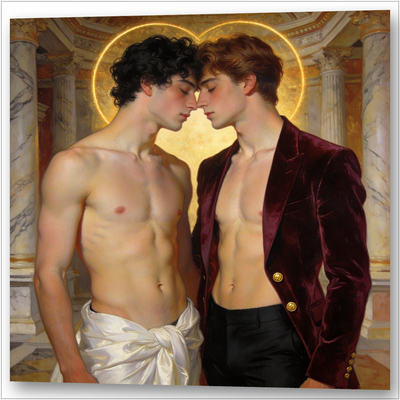
Art history is full of geniuses who died too young. Simeon Solomon did not die too young – he was erased. At 33, he was one of England’s most celebrated painters, darling of the Pre-Raphaelites – en English group of artists who looked to the example of pre-Raphaelite painting and rebelled against the cold perfection of academic art. Their program: intense colors, medieval motifs, radical sensuality. A revolution in Victorian England.
Solomon was the child prodigy in this artistic circle. A friend of Dante Gabriel Rossetti and Algernon Swinburne, admired by Oscar Wilde. At 34, the prodigy became an outcast. His name vanished from exhibition catalogs, his friends turned away, his career was over. The reason: he loved men. And England in 1873 did not forgive that.
The rise – a child prodigy in London
Simeon Solomon was born in London in 1840, into a Jewish family that had already produced two artists – his siblings Abraham and Rebecca Solomon were respected painters. Simeon outshone them all. At 18, he exhibited at the Royal Academy. At 20, he was admitted to the innermost circle of the Pre-Raphaelites – that revolutionary movement that rebelled against academic painting and instead sought beauty, spirituality, and intense sensuality.
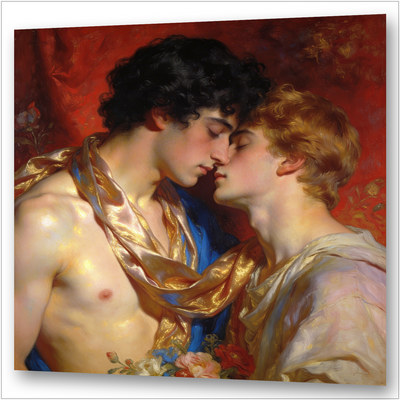
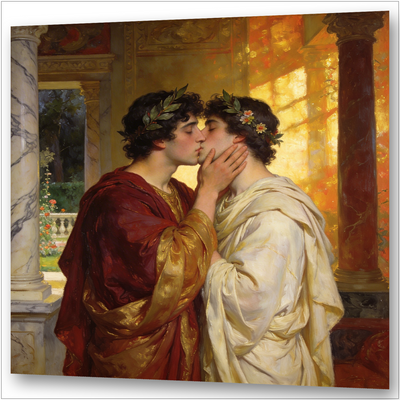
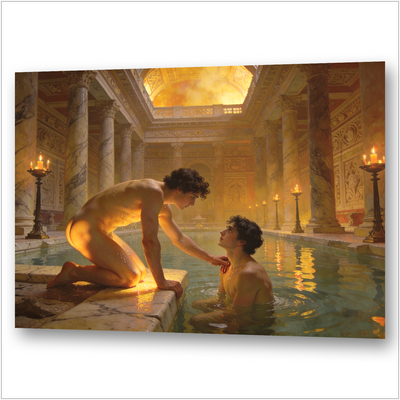
His paintings were different. Where other Pre-Raphaelites painted women – beautiful, suffering, in need of salvation – Solomon painted men. Beautiful, androgynous, tender men. Youths in ancient robes, touching each other. Men who pray and desire, sometimes both at once. The critics admired the technique. The connoisseurs understood what they were seeing.
The circle – Rossetti, Swinburne, Wilde
Solomon moved in a milieu that placed beauty above morality – at least in theory. Algernon Swinburne, the poet and notorious provocateur, was his closest friend. The two shared not only aesthetic convictions, but also a taste for the forbidden. Swinburne wrote about Solomon: "He is the only painter who truly understands what beauty is."
Oscar Wilde, then still a student at Oxford, collected Solomon’s works and quoted him in his essays. The young Wilde saw Solomon as a precursor – a man who gave form to the unspeakable in images before Wilde clothed it in words.
It was a circle of men who knew what they were. And who believed art would protect them.
They were wrong.
The fall – London 1873
In February 1873, Simeon Solomon was arrested in a public toilet in London. The charge: "indecency with a man". He was 33 years old.
What followed was the systematic erasure of a life. His friends turned away – Swinburne distanced himself publicly, Rossetti stayed silent. The Royal Academy shut its doors. Galleries removed his paintings from exhibitions. His name was struck from catalogs, from letters, from art history.
Solomon was convicted. The punishment was comparatively mild – but the social destruction was total.
"Simeon Solomon painted things that others would not even dare to think."
– Oscar Wilde
The final decades – poverty, alcohol, oblivion
Solomon kept painting. He could not stop – art was the only thing that remained. But now he painted for pennies, sold sketches on the street, lived in workhouses. The paintings from this period are smaller, more hurried – but sometimes with an intensity that surpasses his early masterpieces. As if loss had burned away everything superficial and left only the core.
He died in 1905 in a London workhouse. 65 years old. Alone.
Art history barely took notice.
Rediscovery – what the museums left out
Today, Solomon’s paintings hang in Tate Britain, the Birmingham Museum, and private collections around the world. Art scholarship has rediscovered him – as a Pre-Raphaelite, as a Jewish artist, as a queer pioneer. His paintings show what Victorian society did not want to see: that men love each other, tenderly and passionately, beautifully and with dignity.
What museums usually show, however, is the early work – the accepted pieces that can be interpreted as "symbolic" or "spiritual". The explicit, the unambiguous, the bold – that remains in storage.
History in oil
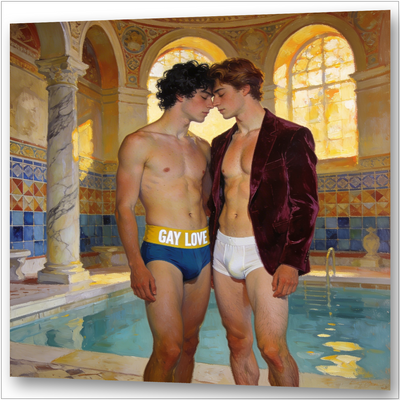
KUNSTWERK BILDER continues Solomon’s work – not as a copy, but as an inspired response. What Solomon had to paint only in hints, because England would otherwise throw him in prison, we show directly. Two men. Their beauty. Their tenderness. Their desire.
Solomon paid for all of it. We owe him clarity.
KUNSTWERK BILDER proudly presents: History in oil.