The Excuse
"We’re just friends." "It’s platonic." Generations of gay men hid behind this term - not out of conviction, but out of fear. Platonic love was not an ideal, but a shield. A socially acceptable formula that legitimized intense relationships between men without having to speak the unspeakable.
Even after the repeal of criminal laws - in Germany in 1969, in England in 1967 - "platonic" remained a hiding place for decades. Criminalization was over, shame was not. And so legal protection turned into a psychological prison: men who could not accept their own identity elevated abstinence into a virtue. No lust, no desire - only pure, spiritual affection. So pure it was barely human anymore. In reality, though, unsurprisingly, clinging to the "platonic" was about as real as the belief of many Catholic priests and even cardinals in celibacy. Despite all the philosophical window dressing, it ended in sex.
What Plato Really Wrote
This is where the great misunderstanding begins. Plato himself never used the term "platonic love." It is an invention of the Renaissance - more precisely, of Marsilio Ficino in the 15th century, a Florentine scholar who translated Plato’s texts into Latin and in doing so... softened them.
What Plato actually wrote reads very differently.
His most famous text about love is called Symposium - Greek for drinking party. It refers to a dinner in Athens at which a circle of educated men takes turns speaking about the nature of Eros. Not an academic seminar, but a lively gathering around the table with wine, wit, and passion.
One of the speakers, the comic poet Aristophanes, tells a myth: originally, the story goes, humans were spherical beings with four arms, four legs, and two faces. Zeus split them apart - and ever since, each person has been searching for their other half. Some spheres were male-male, some female-female, some male-female. In this account, homosexual love is equal and original - not a deviation, not a sin, but one of three equally valid forms of human desire.
Socrates himself reports on a priestess named Diotima, who had explained to him: Eros begins with the beautiful body. One desires a person because he is beautiful. Only from there does one ascend - to the beautiful soul, to beauty as an idea. But the starting point is always the body. No desire, no ascent.
In another dialogue, the Phaedrus - a conversation between Socrates and the young Phaedrus in a meadow outside Athens - Plato describes the love between an older and a younger man with an intensity that is anything but abstract. The soul, he writes, grows wings when it catches sight of the beloved. It trembles, it sweats, it is beside itself. This is not a metaphor for spiritual admiration. This is being in love - physical, overwhelming, sexually charged.
Greek reality: love as education
In ancient Greece - especially in Athens and Sparta, between roughly 600 and 300 BC - love between men was not merely tolerated, it was socially structured.
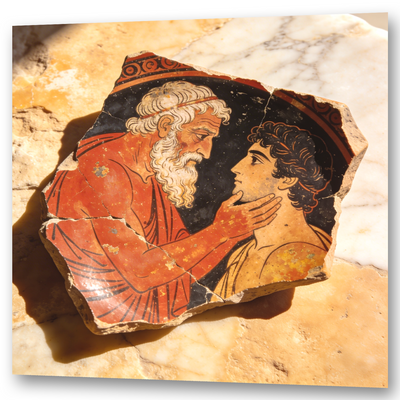
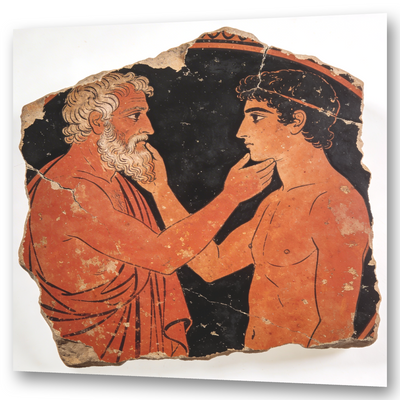
The system even had names: the older man was called Erastes - the lover. The younger was called Eromenos - the beloved. The Erastes, usually between 25 and 40 years old, took responsibility for a youth’s education: he taught him philosophy, the art of war, and social conduct. He was mentor, protector - and lover.
How old was the Eromenos? Not children - but ephebes: youths between about 14 and 18, after the onset of puberty, already considered by ancient standards to be on the way to manhood. The youth’s father had to approve the relationship. The Eromenos, that is, the youth himself, had the right to refuse or to change Erastes. It was not a hidden relationship, but a publicly recognized institution with rules and obligations.
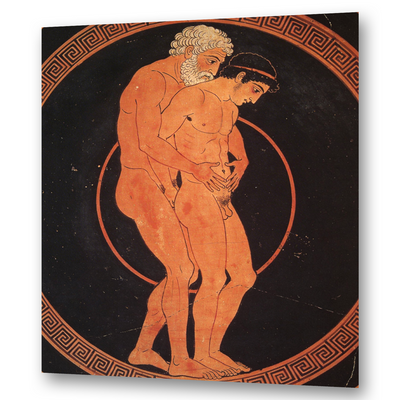
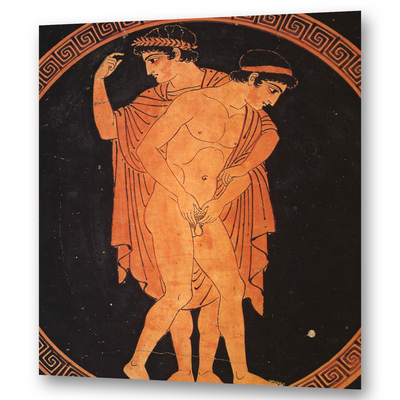
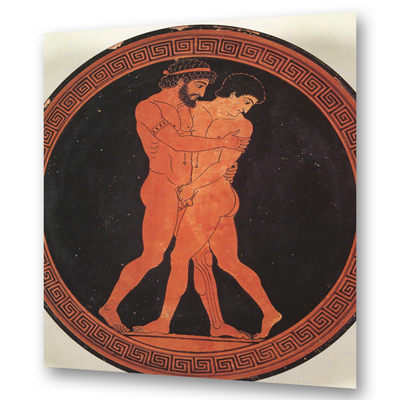
Was this relationship sexual? Yes - but the Greeks discussed exactly how. What was considered honorable was so-called intercrural sex - the man did not penetrate the younger person’s body, but moved between his thighs. This sounds like a strange distinction, but it had a clear basis: the younger partner’s dignity was not to be violated. Penetration was seen as submission - and a free Greek citizen did not submit. Pleasure was permitted, humiliation was not.
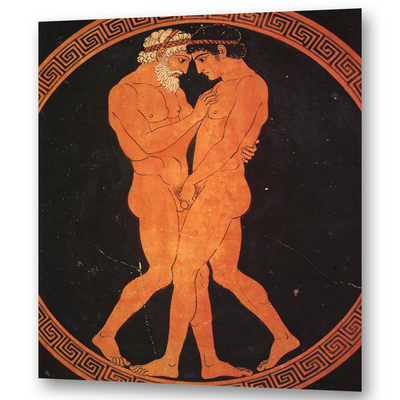
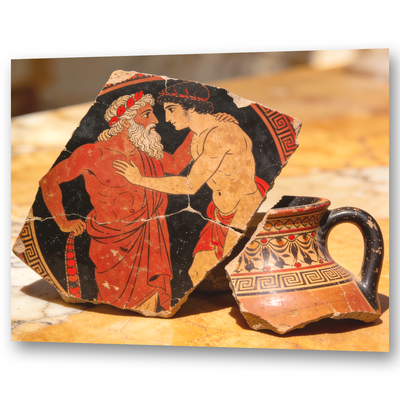
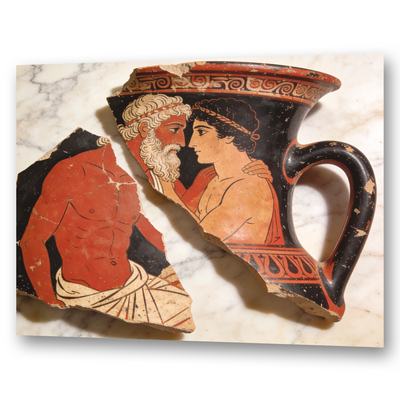
Was the Eromenos only passive? Social norms said yes. Reality was more complicated. In the Phaedrus, Plato himself describes the phenomenon of Anteros - reciprocal love: the younger one also feels desire, he also loves in return, he also wants to touch. The norm was one thing, human nature another. Vase painting shows mutual tenderness, mutual desire - not one-sided submission.
How long-lasting were these relationships? Formally, they ended when the Eromenos became a man - beard, military service, his own civic rights. But many relationships continued as deep friendship, as a lifelong bond. The Sacred Band of Thebes makes this clear: adult men who fought as couples - these were not new relationships, but long-standing, proven love.
Were the Erastes married? Very often yes. Marriage was a civic duty - reproduction, household, continuity of the city-state. Love for a youth was completely separate from that, no contradiction, no infidelity in the ancient sense. Two entirely different spheres of life - both recognized, both expected.
Sparta took this even further. There, love relationships between warriors were a military strategy. The most famous example: the Sacred Band of Thebes - an elite unit of 150 male couples, each made up of a lover and his beloved. The idea behind it was simple: a man fights more bravely when he stands beside the person he loves. The Sacred Band went undefeated for over 30 years - until Alexander the Great destroyed it in 338 BC at the Battle of Chaeronea. The men died without abandoning their formation. Alexander, who defeated them, was himself homosexual - his love for Hephaestion is historically documented. It is said that he wept at the sight of the fallen warriors.
Pederasty and pedophilia - a necessary distinction
The modern reader stumbles over the age of the ephebes - and rightly so. But equating it with pedophilia is historically false and analytically imprecise.
Pedophilia is directed toward prepubescent children, who have no sexual maturity and cannot give consent. Greek pederasty concerned pubescent youths who, by ancient understanding - and by biological maturity - were already on the path to adulthood. The concept of childhood as we know it today did not exist in antiquity. At 14, one was a soldier in training in Athens; at 18, a citizen with rights and duties.
That does not mean we should adopt the system uncritically. It means we must understand it historically - as a product of a society that defined maturity, dignity, and education differently from us. The Greeks created something that worked in its own time and shaped the art history, philosophy, and warfare of Europe. That is the truth - complex, uncomfortable, fascinating.
Did Plato switch positions in the end?
Yes - and that is the crucial point of the whole story.
The old Plato, who in his final years worked on a vast text about the ideal state - the Nomoi, in English: The Laws - sounds like a different person. He describes homosexual sex as "against nature." He demands abstinence. He wants the state to suppress relationships between men.
Why this break? Scholarship is divided. Some see an old, embittered man who viewed the world more harshly after the failure of his political projects in Sicily. Others suspect the influence of the Pythagoreans - a philosophical sect that preached asceticism and hostility toward the body. Still others believe it was political calculation: an ideal state needs children, therefore reproduction, therefore heterosexuality.
The Renaissance seized precisely on this late, severe Plato - and ignored the early, sensual one. Ficino, the translator, may himself have been homosexual, but he lived as a cleric in the Church. He needed a Plato without sex. He found him in the Nomoi and projected him back onto the entire body of work - onto the Symposium, the Phaedrus, onto everything. You could also put it more directly: Ficino invented platonic love because he needed it himself.
The result: 2,000 years of "platonic love" as a cover - based on the selective reading of an old man who had denied his own youth, interpreted by a cleric who had to hide his own nature.
Homosexual art in ancient Greece
The Greeks did not hide their eroticism. They painted it on vases, carved it in marble, poured it into poems - and these works now stand in the great museums of the world, often without visitors understanding what they are seeing.
Vase painting: Hundreds of Attic drinking cups and storage vessels show Erastes and Eromenos - courting, touching tenderly, having sex. The scenes are explicit, but not pornographic: they show the ordinary. Many of these vases are now in the National Museum in Athens, the Louvre, and Berlin’s Museum of Antiquities. No fig leaf, no allegory - just life as it was. Anyone walking through Berlin’s Museum of Antiquities today and looking closely can see it. The museum texts mostly remain silent about it.
Sculpture: The Kouros - the naked youth - is the central motif of archaic Greek sculpture. Hundreds of these figures have survived: young men, completely nude, frontal, with a slight smile. They stood in temples and on graves. Whether they were intended purely as religious images or were also erotically charged - the Greeks would not have understood the question. For them, beauty was always both.
Lyric poetry: The poet Pindar celebrated the victors of the Olympic Games - and their bodies - with an enthusiasm that goes far beyond athletic admiration. Ibycus described the sight of a beautiful boy like a lightning strike that hits him out of nowhere. Sappho, who lived on the island of Lesbos - hence the word "lesbian" - wrote the most intense love poems of antiquity, addressed to women. Antiquity itself called her the "tenth muse." Her homosexuality was no scandal. It was part of her greatness.
What remains?
Platonic love is a later invention, born of fear - the fear of an old philosopher before his own desire, the fear of a Renaissance cleric before the Church, the fear of gay men before persecution and prison.
The ancient Greeks, in whose name this concept claims authority, would not have understood it. Or would have laughed at it.
When KUNSTWERK BILDER shows gay art, it connects to a tradition older than Christianity, older than shame, older than hiding.
The Greeks painted it. We show it.