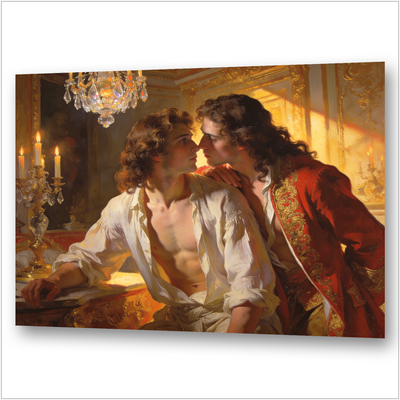
It was the most magnificent court in Europe—and the most decadent. Louis XIV, the Sun King, had turned Versailles into a universe of gold, mirrors, and ceremony. Every morning the Lever du Roi: The king rose, and all the French high nobility stood by. Who was allowed to be there, who was not—that decided ascent and downfall. Power smelled of powder and candle wax. And right in the middle of this glittering cage of etiquette and intrigue lived Philippe de Bourbon—the king's brother, known as “Monsieur” — and his great love. The love of a man. Gay at the Palace of Versailles. Open. Fearless. For decades.
But Versailles was not a palace—it was a control machine. Louis had drawn the nobility out of their castles and forced them to Versailles. Whoever was not there lost influence. Whoever was there had to watch the Lever as the king put on his shirt every morning—and regard that as a privilege.
Absolute power through the absolute humiliation of the nobility. Elegantly wrapped in gold and mirrors.
Monsieur – the king's brother Philippe de Bourbon (1640–1701), Louis XIV's younger brother, was known at court as “Monsieur.” He was handsome, charming, loved parties, jewelry, and men. That was no secret—not to the king, not to the court, not to the chroniclers of the time.
We know this thanks to a man who wrote everything down: Louis de Rouvroy, Duke of Saint-Simon (1675–1755). He lived at court, observed, took notes—and spared no one. His memoirs span thousands of pages and are regarded as one of the most precise records of court life under Louis XIV. Saint-Simon was no gossip reporter—he was an aristocrat, an insider, an eyewitness. What he wrote had substance. And he wrote a lot about Philippe.
“Monsieur loved men openly and without embarrassment, and the king tolerated it because he loved him—and because Monsieur never reached for power.” – Duke of Saint-Simon, Memoirs
The Chevalier – handsome, dangerous, indispensable Philippe de Lorraine (1643–1702) was highly noble, exceptionally handsome, and completely focused on a single relationship. What he had: Philippe d'Orléans. And Philippe had him. Completely, passionately, for decades. Saint-Simon describes him as dominant, manipulative, calculating. He systematically sabotaged Philippe's first marriage to Henrietta of England.
Philippe was married twice—both times for reasons of state, both times an open spectacle. His first wife, Henrietta of England (1644–1670), was intelligent, ambitious, and desperate. She knew she had no chance against the Chevalier in her marriage to Philippe. He isolated Philippe, poisoned the relationship, and made himself indispensable. When Henrietta suddenly died in 1670—at 26, after a glass of chicory water, within hours—the shock at court was enormous. Poisoning?
Suspicion fell on the Chevalier. Nothing was proven. But Saint-Simon left no doubt about what he thought. The Chevalier de Lorraine had Henrietta on his conscience. Not with his own hand—but through poison, through influence, through one of the countless dark channels open at the court of Louis XIV to anyone who had power and was ruthless enough to use it. Saint-Simon did not write it as an accusation—he wrote it as a fact everyone at court knew and no one spoke of aloud.
Philippe's second marriage to Liselotte of the Palatinate was more honest—at least in its hopelessness. Liselotte knew from the start what she was in for.
When Henrietta suddenly died in 1670, suspicion also fell on the Chevalier. Nothing was proven. But the court whispered.
Louis XIV intervenes—and banishes the Chevalier The Chevalier's influence grew too great. Louis XIV acted: exile. Philippe was at rock bottom, begged, pleaded. The Chevalier returned. Love was stronger than politics.
Liselotte of the Palatinate – the wife who saw everything “The Chevalier de Lorraine is the evil spirit of my husband. He has him completely in his power. I am the wife—but the Chevalier is the master of the house.” – Liselotte of the Palatinate, Letters
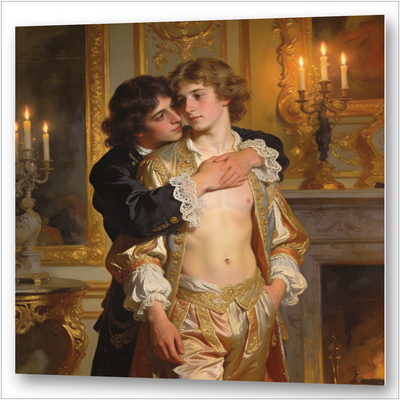
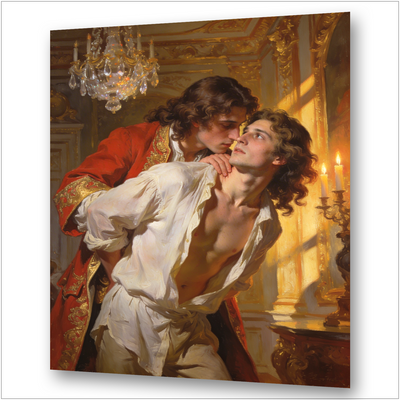
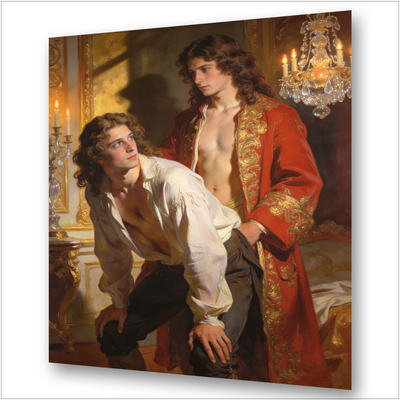
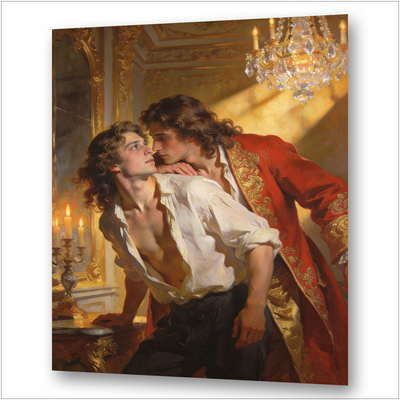
Fragonard painted everything—except that He saw the parties, the intrigues, the passions. He painted desire with a mastery that remains unmatched to this day. But always man and woman. Never Philippe and his Chevalier—although their love was as visible as the chandeliers in the Hall of Mirrors. Art history stayed silent. We did not.
History painting in oil ARTWORK PICTURES takes over Fragonard's technique, his brushwork, his bold artistic mastery—and creates images that would have been worthy of him. And the court painter can only watch.
ARTWORK PICTURES proudly presents: History painting in oil.