Introduction: Stating a provocative truth
Let me be blunt right away: Gay men love dick. Period. That's not surprising, not news, and definitely nothing to be ashamed of. And yet it's still a topic that's treated with a certain discomfort in many conversations - even within the LGBTQ+ community. But why should we hide? Why should we sugarcoat our natural urges, our desire, and our sexuality or hide them behind euphemisms?
This blog post is about desire, lust, the sexual energy that drives gay men. It's about recognizing that desire not as something dirty or wrong, but as a natural, important part of our identity. In a world that forced us for so long to hide our sexuality, celebrating it openly is revolutionary.
Desire for dick is not just a physical attraction - it's an expression of freedom, self-determination, and a refusal to squeeze ourselves into the boxes society has prepared for us. It's a statement. And in this blog post, we want to explore why that desire matters so much, how it has manifested throughout history and culture, and how we can live it authentically in our modern lives.
Historical context: Sexuality in gay history
To understand where we stand today, we have to look back. The history of gay culture is closely intertwined with the history of sexuality - and with the suppression of that sexuality.
The dark times: oppression and secrecy
For centuries, homosexual sexuality was not just taboo - it was illegal, dangerous, and associated with severe punishment. Gay men had to hide their desire, suppress their longing, conceal their true feelings behind masks. Sexuality was not just private - it was criminal. In many countries, homosexuality remained punishable well into the 20th century. In Germany, for example, there was the notorious Paragraph 175, which criminalized homosexual acts. This paragraph was not just a law - it was a symbol of oppression, shame, and rejection.
During this time of oppression, an underground culture developed. Gay men met in secret bars, in dark corners, in spaces ignored by society. These places were dangerous, yes, but they were also places of freedom. Here, men could be themselves. Here, they could live out their desire without constantly looking over their shoulder. These secret spaces were places of resistance.
The liberation movement: Stonewall and beyond
The turning point came in 1969 with the Stonewall riots in New York. When the police tried to raid a gay bar, people fought back. And that moment - that moment of refusing to be oppressed any longer - marked the beginning of the modern gay liberation movement.
Suddenly, it was no longer just about secrecy and hiding. It was about visibility, pride, and demanding rights and recognition. The movement was radical. It was sexual. It was provocative. And it was necessary.
In the 1970s and 1980s, gay culture flourished. There were Pride parades, art movements, an explosion of creativity and self-expression. Artists like David Hockney painted gay men, gay bodies, gay desire - not hidden, not softened, but in all their beauty and sensuality. Art became a place where the truth could be spoken.
The AIDS crisis and its impact
Then came the AIDS crisis. In the 1980s and 1990s, hundreds of thousands of gay men died. The disease became a weapon against the community. Conservative politicians and religious leaders used the crisis to condemn gay people, portray their sexuality as sinful, and present their desire as the cause of suffering.
But the community responded with resistance. ACT UP, quilt projects, art installations - all of these were ways to honor the dead and fight for the living. And in that struggle, one thing became clear: Our sexuality is not the problem. Stigma, discrimination, inadequate healthcare - those are the problems.
The AIDS crisis changed gay culture profoundly. It made sexuality a political issue. It showed that our bodies, our desire, our sexuality are not private - they are political. And they are worth protecting and celebrating.
Psychological perspective: Sexual attraction and desire
Now let's move to the psychological level. What is it that drives gay men's desire for dick? Is it simply biology? Is it psychology? Is it culture? The answer is: it's all of it together.
The biology of attraction
First of all, there is the biological reality. Gay men are sexually attracted to other men. That is not something you "cure" or "overcome" - it is a fundamental part of who we are. Sexual attraction is deeply rooted in our neurobiology.
When a gay man sees another man he is attracted to, things happen in his brain. Dopamine is released. The reward system is activated. It is the same system that is activated in heterosexual men when they see a woman they are attracted to. It is not different, it is not less legitimate - it is simply directed differently.
And yes, the penis is a central part of that attraction. The penis is not just a reproductive organ - it is a symbol of masculinity, strength, and sexuality. For gay men, another man's penis is an object of desire, lust, and fantasy. That is completely normal, completely natural.
Psychological factors: desire and identity
But it goes beyond pure biology. The psychology of sexual attraction is complex. It is about identity, power, and recognition.
For many gay men, desire for dick is also a desire for masculinity. It is a desire for what they themselves are or want to be. There is a deep psychological component here - the idea that we see in others what we see in ourselves or want to see in ourselves.
It is also about power and submission. Sexual fantasies are often tied to power dynamics. For some gay men, desire for dick is linked to the wish to submit, to be controlled. For others, it is tied to the desire to be in control, to be dominant. These power dynamics are a natural part of human sexuality.
Natural urges vs. social norms
Here is the important distinction: there is a big difference between natural urges and social norms. Our natural urges are biological, psychological, authentic. Social norms are constructed, often repressive, often designed to control us.
For decades, gay men were told that their natural urges were wrong. That their desire for dick was a sin, a disease, a perversion. These messages are deeply embedded in our psyche, even when we consciously reject them.
But the truth is: Our natural urges are not wrong. They are not evil. They are simply natural. And it is time to accept them, celebrate them, and live them out - in safe, consensual, and respectful ways.
Cultural representation: Gay art and aesthetics
Culture is a place where we can express our deepest truths. And gay culture has always been a culture of desire, eroticism, and sensuality.
David Hockney and the artists of liberation
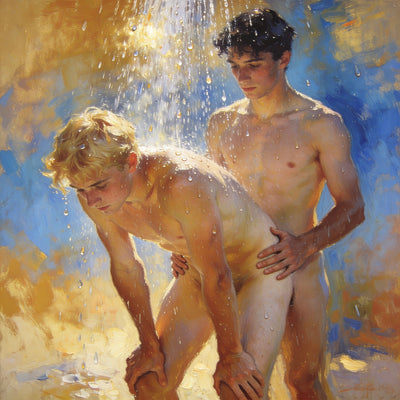
David Hockney is one of the most important artists of modern gay culture. His works are not just beautiful - they are radical. They show gay men, gay bodies, gay desire in all their splendor. His paintings of swimming pools, naked men, and erotic scenes are not hidden, not softened - they are open, sensual, wonderful.
Hockney was not alone. There were many other artists who celebrated desire for dick in their art. Tom of Finland created iconic images of muscular, sexual men. Robert Mapplethorpe photographed the male body in all its beauty and eroticism. These artists were pioneers. They showed that gay desire is not something that must be hidden - it is something that can be celebrated.
Eroticism in the art world
Eroticism is a central theme in the art world. Artists have always engaged with sexuality, desire, and the human body. But for gay artists, this was especially important. Their art was an act of resistance, an act of liberation.
Gay erotic art is not just sexual - it is political. It is a statement against oppression, against shame, against stigma. It says: We are here. We are sexual beings. We are beautiful. And we will not hide.
Pride design and queer art
In modern times, gay art has continued to evolve. There is now an entire industry of Pride design, queer art, and products that celebrate gay desire and identity. From T-shirts with erotic motifs to wall art that showcases the beauty of the gay body - the culture has changed.
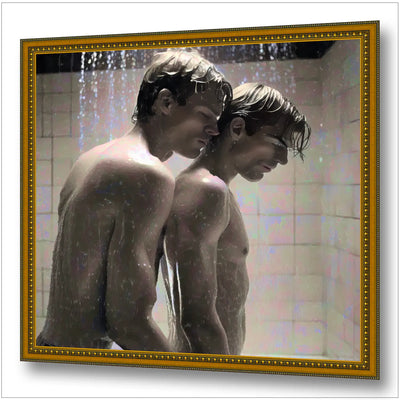
Kunstwerk Bilder is a perfect example of this. The shop offers LGBTQ+ and gay bedroom wall art, posters, and mugs with erotic motifs, far removed from pornography and explicit sexual depictions, as well as Pride design and queer art of an artistic standard. These products are not just decorative - they are a statement. They are a celebration of identity, desire, and authenticity. They allow gay men to fill their spaces with images that reflect their truth.
Modern gay culture: Dating, relationships, and sexual freedom
What does modern gay culture look like? How do gay men live out their sexuality today?
Dating and relationships in the digital age
The digital revolution has transformed gay culture. Dating apps like Grindr, Scruff, Gayroyal, Romeo, and others have made it easier for gay men to connect. This has not been without problems - these apps have also led to superficiality and to reducing people to their bodies and sexual preferences. But they have also created unprecedented freedom.
Gay men can now openly and without punishment seek sex without having to hide. They can express their preferences, share their fantasies, live out their desire. That is enormous progress compared with the days when people had to meet in dark bars and constantly fear arrest.
But dating is not just sex. Many gay men are also looking for relationships, love, and connection. And modern gay culture has made that possible too. There are now millions of gay couples living together, getting married, and starting families. Desire for dick is not the opposite of love - it can be a part of it.
Sexual freedom and self-determination
One of the most important things modern gay culture has achieved is sexual freedom. Gay men have the right to live out their sexuality however they wish. That does not mean there are no boundaries - safety, consent, and respect still matter. But it does mean that we are no longer forced to hide or deny our desire.
This freedom is not something to be taken for granted. It was fought for through decades of activism and resistance.