June 28, 1969. The Stonewall riots marked the beginning of the modern LGBTQ+ liberation movement. But what many people don’t know is this: the art world played a crucial role in making that movement visible, documenting it, and driving it forward.
Before Stonewall, gay artists used codes, hints, hidden symbols. After Stonewall, there was a radical shift: open, political art that explicitly aligned itself with the liberation movement. Artists became activists. Art became a weapon.
Thomas Lanigan-Schmidt: The Artist in the Uprising
Thomas Lanigan-Schmidt was one of the few visual artists actually present during the raid at the Stonewall Inn. He was right in the middle of it, as bottles flew and the street burned.
That same year, 1969, he created the sculpture Allegory of the Stonewall Riot – a work made from glittering everyday materials, kitsch aesthetics, aluminum foil, plastic. It was a deliberate provocation: the uprising as a heroic act, celebrated with the cheapest materials society allowed queers to have.
Lanigan-Schmidt showed that gay art does not have to be "high art" to matter. It can come from the grime of the street, from the sparkle of drag bars, from resistance itself.
Andy Warhol: The Silent Witness
By 1969, Andy Warhol was already a global superstar. Politically, he usually kept his distance, watching, detached. But his Factory was a safe space for queer outsiders, drag queens, trans people – long before that was socially acceptable.
In 1975, Warhol portrayed the Stonewall icon Marsha P. Johnson – a Black trans woman who fought on the front lines in the first night of the uprising – in his series Ladies and Gentlemen. Warhol’s portraits gave Johnson and other trans activists a kind of high-cultural visibility society otherwise denied them.
Warhol didn’t just document. He elevated. He turned the heroes of Stonewall into icons of art history.
Keith Haring: The Artist-Activist
When Stonewall happened, Keith Haring was still a child. But in the 1980s, he became the embodiment of the artist-activist – an artist whose work would be almost unthinkable without the freedoms won through Stonewall.
Haring was openly gay. He used his art as a weapon – against the AIDS crisis, for LGBTQ+ rights, for visibility. His iconic figures – dancing, embracing, loving – were radical statements at a time when gay men were stigmatized as "disease carriers".
Haring painted in subway stations, on streets, on walls. Art for everyone, not just galleries. His Keith Haring Foundation is today one of the most important supporters of queer projects and historical preservation.
Haring showed that gay art does not have to be hidden. It can be loud, colorful, public. It can reclaim the street.
Jean-Michel Basquiat: The Intersection
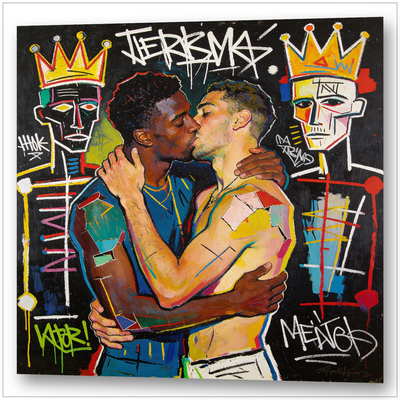
Jean-Michel Basquiat focused primarily on racism, class struggle, and Black identity. He did not explicitly position himself as part of the Gay Liberation movement. But he was close friends with Haring and Warhol and moved in the same queer underground scene. Basquiat’s work is often shown today in exhibitions about the "post-Stonewall era" because he represents the intersection: Black identity, queer scene, street art, resistance. His crowns were statements of power – for all marginalized people, not just one group.
Basquiat showed that liberation movements overlap. The fight against racism and the fight for LGBTQ+ rights are not separate – they are part of the same struggle for dignity and visibility.
Roy Lichtenstein: Institutional Support
Roy Lichtenstein largely kept out of explicitly queer politics. There is no evidence of a direct public statement on Stonewall.
But the Roy Lichtenstein Foundation later played a major role in supporting exhibitions such as Art After Stonewall, helping to examine the movement’s impact on art history. This shows that even artists who did not personally take a public stance contributed to visibility through their institutions.

The cultural shift: From codes to clarity
Before Stonewall, gay artists had to hide their identity. They used codes, hints, metaphors. Gay love was presented as "friendship," gay desire as "artistic inspiration."
After Stonewall, there was a radical break. Artists like Robert Mapplethorpe photographed gay sexuality explicitly, provocatively, confidently. David Hockney painted gay couples by the pool, naked, in love, visible. Nan Goldin documented the lives of queer people in New York – unfiltered, raw, real.
The message was clear: We are no longer hiding. We are here. We are queer. Get used to it.
The Gay Liberation Front and the artists
The Stonewall riots led to the founding of the Gay Liberation Front (GLF) – a radical movement that fought not only for rights, but for complete social transformation.
Many artists became involved in the GLF. They designed posters, organized exhibitions, created art for demonstrations. Art became a tool of liberation – not just aesthetically, but politically.
The GLF showed that gay liberation is not only a question of laws, but of culture, visibility, and self-confidence. And artists were the avant-garde of this cultural revolution.
Art After Stonewall: The reckoning
The exhibition Art After Stonewall, 1969–1989 documented the artistic response to Stonewall in 2019 (on the 50th anniversary). It showed:
– How artists visually shaped the liberation movement
– How the AIDS crisis mobilized the art world
– How queer art moved from the margins to the center of art history
The exhibition made it clear: without Stonewall, there would be no queer art as we know it today. Without artists, there would be no visibility for the movement.
Why this still matters today
At a time when LGBTQ+ rights are once again under pressure, it is more important than ever to remember the role of art. Artists did not just document the gay movement – they shaped it, drove it forward, and made it visible.
Art is not just decoration. Art is resistance. Art is visibility. Art is power.
That is why at KUNSTWERK BILDER we create works like Stonewall '69 in the Basquiat style – not out of nostalgia, but as a reminder that freedom must be fought for. Again and again.
→ To the W. Schwamborn edition: Gay art with attitude
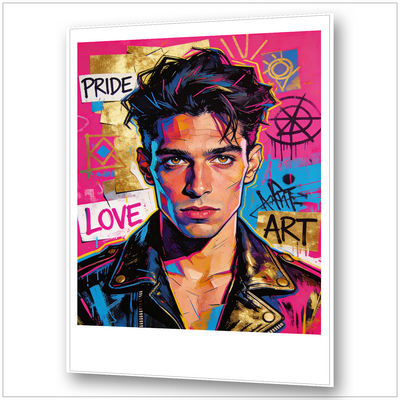
KUNSTWERK BILDER makes gay art visible – in the tradition of Warhol, Haring, Basquiat, and all the artists who had the courage to be loud after Stonewall.