A red button. White script lettering. "Gay Love - it's the real thing". Anyone who wore this pin in the 1970s was making more than a fashion statement. They were hijacking one of the most famous advertising slogans in history and turning it into a manifesto of gay self-assertion.
"Coke is the Real Thing" - Culture Jamming in the 1970s
"Coke is the Real Thing" was one of the most successful advertising slogans of all time between 1969 and 1975. Coca-Cola was selling not just a drink, but a promise: authenticity. Genuineness. The original.
That was exactly the message LGBTQ+ activists made use of. At a time when homosexuality was defamed as "unnatural", "artificial", or "pathological", they stole Coca-Cola's promise and declared gay love to be the "Real Thing" - the truth, the original.
The subversion was perfect: the eye immediately recognized the familiar Coca-Cola aesthetic - red color, sweeping Spencerian script, the iconic design. But the text broke expectations and forced people to confront a topic that was taboo at the time. Today, this technique is called culture jamming: hijacking the visual language of capitalism and turning it against itself.
The slogan spread on buttons, stickers, posters - cheaply produced, distributed decentrally, art for the street. No gallery scene, no art market logic. A wearable statement that anyone could wear. A precursor to modern street art, in the tradition of Andy Warhol's Pop Art, which elevated consumer goods to the status of art. Activists went one step further: they turned a consumer product into a tool for civil rights.
Today, these buttons are museum pieces - at the Atria Institute in the Netherlands, in the collections of Queer Heritage South. Historical cultural artifacts of a movement that fought for visibility, button by button.
Cologne, 1978 - A personal ad that never appeared
Nine years after Stonewall. In Germany, Paragraph 175 is still in force - homosexuality is still partly punishable by law, socially ostracized. Gay men search for each other through personal ads in newspapers. It is the only way.
Winfried Schwamborn remembers the fear even among liberals in the reality of West Germany:

Winfried Schwamborn 1976 |
Winfried Schwamborn became known as the author of the "Handbook for Conscientious Objectors" (1972) and as the editor of "The Gay Book. Loving, Fighting, Living" (1982). Today, Winfried Schwamborn curates our gay fine art products at KUNSTWERK BILDER. |
"April 1978. I am sitting in Cologne writing a personal ad that I want to publish in the Frankfurter Rundschau. The FR is considered liberal, progressive. It accepts personal ads from gay men - a rarity, one of the few newspapers in the Federal Republic of Germany that does so at all. Inspired by the hijacked Coke slogan, I choose as the headline: "Gay Love is the Real Thing".
The ad is rejected. Too provocative? Too political? Perhaps also fear of Coca-Cola. The FR printed gay personal ads, yes - but please discreetly, please unobtrusively; the gay ads were just not allowed to be too gay. "Gay Love is the Real Thing" was too loud, too self-confident, too visible.
Do you understand how cumbersome the whole thing already was back then? I write a letter in Cologne. Send it to Frankfurt. Pay for the ad by bank transfer (expensive, charged per line). Wait for the weekend edition. Hope for replies. The replies go to the newspaper, by box number, as it was called, not to me. The FR collects them - for ten days. Then it sends the letters. I read them. I ask one who wrote interestingly for a photo by letter. If I'm lucky, a poor-quality passport photo arrives two weeks later. Weeks pass before an ad may possibly turn into a meeting.
And some ads came to nothing anyway back then. Because simply no one replied. Or because my slogan "Gay Love is the real thing" was too bold for the time."
Today you open Grindr. Swipe. Romeo. Chat. Meet. All within an hour.
In 1978, gay love was "the real thing" - but it wasn't allowed to be called that.
Coca-Cola - From Silence to Pride
Back then, Coca-Cola did not respond to the "abduction" of its slogan. No press release, no legal action, no comment. Why? The spread was decentralized, organic, non-commercial, a banner here, buttons there. Hard to track, risky from a PR perspective. And Coca-Cola had other priorities: the "Cola Wars" against Pepsi were raging, and the marketing department was fighting for the young "Pepsi Generation".
Culture jamming was ignored as long as it did not threaten the mass market.
Today, the attitude has completely changed. In 2019, Coca-Cola ran posters in Hungary featuring same-sex couples and the slogan "Zero Sugar, Zero Prejudice". Conservative politicians called for a boycott. Coca-Cola refused to remove the posters and emphasized its commitment to diversity and inclusion. Since 2006, the company has regularly achieved top scores in the Human Rights Campaign's Corporate Equality Index.
What was once subversive is now mainstream. Coca-Cola runs Pride campaigns itself. "Love is Love" is printed on the cans.
From Subversion to Visibility
The story of "Gay Love is the Real Thing" is the story of gay visibility. In the 1970s, you had to hijack Coca-Cola to say: We are real. We are genuine. Our love counts.
In 1978, Winfried's personal ad was censored - by a liberal newspaper that printed gay ads, but not too loudly, not too visibly.
Today, Coca-Cola itself carries the rainbow flag. What was once protest has become advertising. Some call that appropriation. Others call it progress.
Both are true. But one thing is certain: visibility was not given. It was fought for. Button by button. Ad by ad. Every time someone wore "Gay Love is the Real Thing", he was saying: I am here. I am real. I am not hiding.
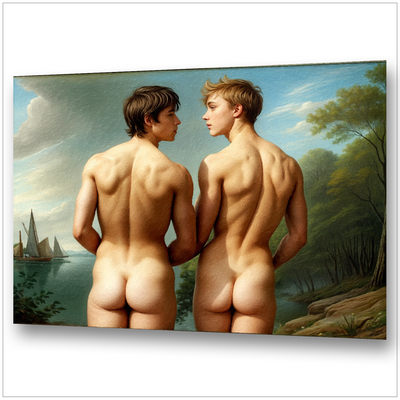
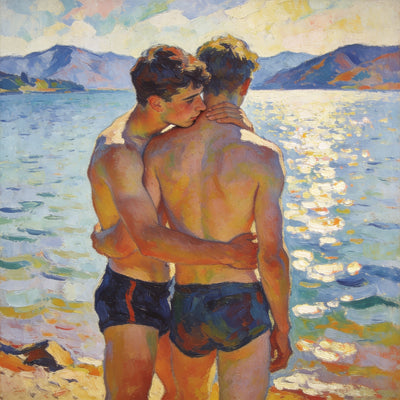
And that is exactly what KUNSTWERK BILDER does today: make gay art visible. Not hide it, not veil it, not discreetly. But loudly, confidently, authentically.
Because gay love has always been "the real thing" - even if it took decades for the world to accept it.
This blog post is part of our series on LGBTQ+ history, activism, and visibility. Discover our collection of gay art - each picture a statement for authenticity and self-determination.