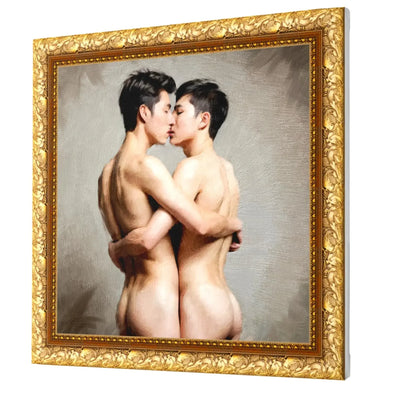
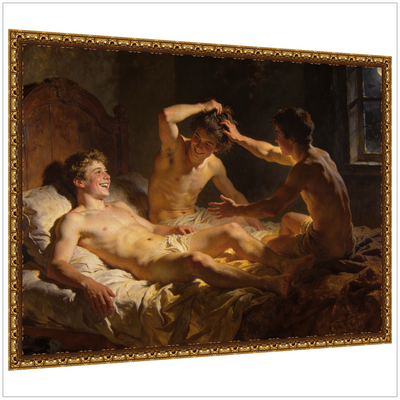
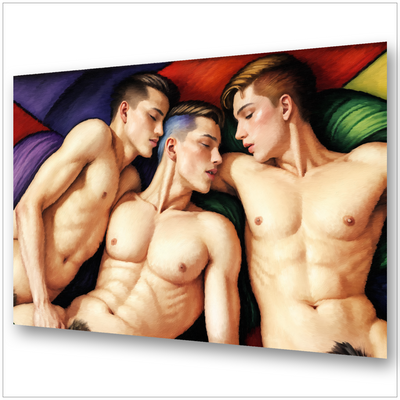
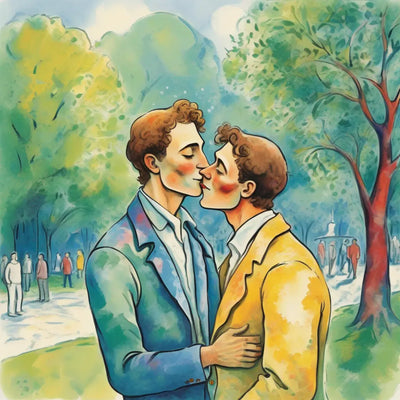
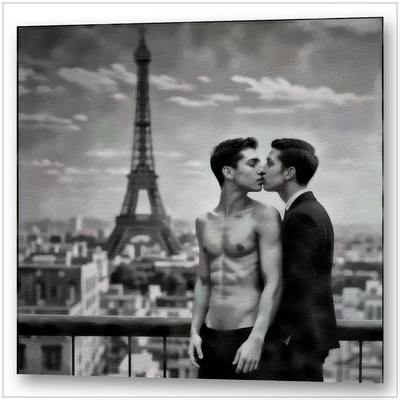
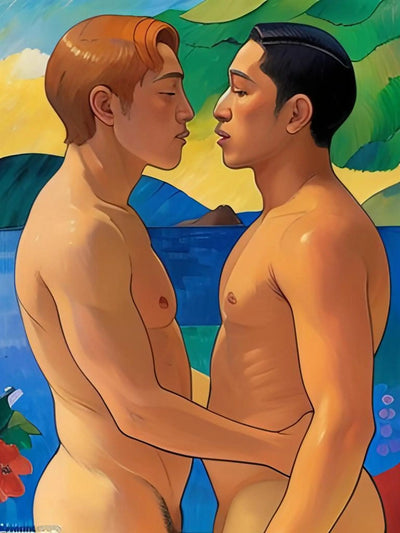
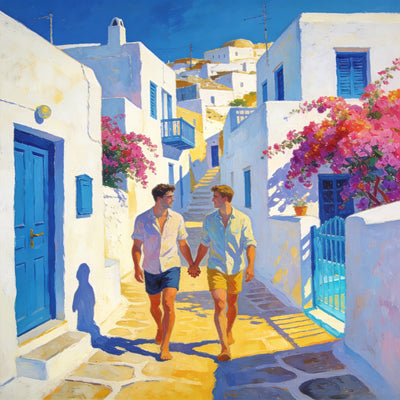
Making gay art visible is not merely a niche project or a passing trend - it is a matter of justice, remembrance, and cultural integrity. Our slogan says it clearly: "KUNSTWERK BILDER makes gay art visible". In this article, I explain why this visibility is necessary, why homosexual people have always existed, why their depictions in visual art are often missing or were concealed, which historical mechanisms lie behind this, and how the situation has developed up to the present day - including counter-movements and current setbacks.
Why visibility matters
Visibility in art means more than presence in exhibitions or books. It creates identity, conveys historical continuity, and offers role models. When gay artists and subjects are omitted, a distorted picture of cultural history emerges - as if homosexuality were a marginal or modern phenomenon rather than a constant human reality.
Visibility also helps reduce prejudice and promote social recognition. Art can create empathy, open perspectives, and reflect power structures. That is why it is important to deliberately highlight depictions and biographies that were made invisible for a long time.
Homosexuality has always existed - why are the depictions missing?
Historically, same-sex love and desire have existed in every era. Archaeological and literary sources from ancient Greece and Rome show that homoerotic relationships were known and accepted in parts of society. Nevertheless, visual depictions of homosexual sexuality or partnerships have been rare for centuries - for several reasons:
- Religious and moral norms: In many cultures, sexual acts outside heterosexual marriage were regarded as sin or wrongdoing. Christian moral concepts shaped Europe for centuries and led to the stigmatization of same-sex acts.
- Laws and prosecution: Sodomy laws, such as provisions against "fornication" or "sodomy", criminalized homosexual acts. That made open depictions dangerous - for artists, models, collectors, and patrons.
- Social taboos and moral guardians: The policing of morals, censorship authorities, and family expectations led artists to address homoerotic themes only in coded form or not at all.
- Economic pressure: Artists who depended on patrons could not openly pursue risky subjects without losing commissions.
Hidden depictions and coded visual language
Because direct depictions were risky, artists often developed subtle strategies: mythological disguises (Ganymede, Hyacinthus, Apollo, and other figures), ambiguity in pose, symbolism, and androgynous ideals of beauty. This allowed them to make homoerotic references that insiders understood - while authorities could interpret them as "classical" or "mythological" subjects.
Examples of historical coding
- Ancient vases and sculptures: open homoerotic depictions in Greek art.
- Renaissance and Baroque: classical myths were used as vehicles for homoerotic themes.
- Modern era: artists such as Michelangelo or later Caravaggio are often interpreted through the homoerotic aspects of their images and biographies - but often without explicit public acknowledgment of their desires.
Persecution, censorship, and historical examples
The persecution of homosexual people is historically documented and also affects the sphere of art and culture. Here are some clearly documented turning points and examples:
Mid-19th to mid-20th century
- Laws against homosexuality: In many European countries and in North America, homosexual acts were punishable by law. This had a massive effect on public representation.
- Magnus Hirschfeld: His Institute for Sexual Science in Berlin (founded in 1919) was an international center for research and collecting. In 1933, it was looted by the National Socialists and its library was burned - a clear example of how homophile research and culture were destroyed.
Nazi era and the Holocaust
Under the Nazi regime, thousands of men were arrested under Paragraph 175 and deported to concentration camps; the persecution also affected cultural workers. The disappearance of collections, the destruction of publications, and the murder of people led to a deep rupture in the historical transmission of gay culture.
Postwar period and ongoing repression
Even after 1945, many countries remained repressive: laws against homosexuality stayed in force, social norms were conservative, and many artistic works with explicitly gay content were censored as obscene or not shown at all. In Germany, for example, Paragraph 175 was only gradually reformed and was not fully repealed until 1994 - until then, legal persecution continued to affect generations.
Attempts at censorship in the second half of the 20th century
The second half of the 20th century brought greater visibility on the one hand, but also new censorship battles on the other:
- Obscenity trials: In the 1950s-70s, queer-erotic art in many countries was confronted with obscenity laws - images and publications could be confiscated or banned.
- NEA and the culture wars of the 1980s/90s (USA): Artists such as Robert Mapplethorpe became the focus of public debates about state arts funding and "offensiveness" - a prominent example of the culture wars that also affect gay art.
- AIDS crisis: The epidemic of the 1980s led to polarization: art was used to draw attention to the crisis, while at the same time there were political and moral attacks on that visibility.
Were there approaches among painters and sculptors?
Yes. Despite restrictions, many artists worked with homoerotic subject matter - sometimes openly, but mostly in coded form. In the modern and contemporary periods, more and more artists then became visible who addressed their sexuality:
- Photography and printmaking gave homoerotic depictions a new expressive format (e.g. Wilhelm von Gloeden, later Robert Mapplethorpe).
- Painting and drawing: homoerotic suggestions existed even in earlier centuries; in the 20th century these themes became more explicit, for example in the work of artists who were part of the queer subculture.
- Sculpture and performance offered space for bodily representation and political statement - both important for gay visibility.
What matters is this: many of the best-known works that are read as "queer" today were deliberately kept ambiguous at the time they were created or were only later reinterpreted in a queer context.
When did relative freedom begin?
The development came in stages and differed by region. Some milestones:
- Postwar period to the 1960s: Slow social shifts; the first scholarly and cultural engagements with sexuality.
- 1960s-70s: The sexual revolution, Stonewall (1969) in the USA, and the emergence of gay movements in Europe led to greater visibility and political demands.
- 1980s-90s: Despite the AIDS crisis, there was more public debate; some countries legalized consensual homosexual acts (e.g. UK 1967 partial reform; Germany gradual reform, full repeal of §175 in 1994). The art and museum world gradually began to take queer themes more seriously.
- 2000s to today: In many Western countries, legal equality (marriage, protection from discrimination) and cultural recognition grew; museums, galleries, and institutions systematically present queer perspectives.
The current setback: Is there a rollback underway?
The situation is ambivalent. On the one hand, there is visibility on a scale never seen before: queer retrospectives in major museums, queer biennials, queer collections, and thriving online platforms enable broader reception and exchange. On the other hand, we are seeing:
- Political counter-movements: Authoritarian and conservative regimes are tightening laws against "propaganda" or same-sex "promotion" (e.g. Russia 2013), and in some countries homosexuality and queer visibility are being deliberately criminalized.
- Culture wars: In many societies, funding, exhibitions, or school materials become targets of political conflict. In such debates, queer art can be discredited as "transgressive."
- Digital moderation and platform policy: Content moderation ("nudity" guidelines, community standards) often affects queer-erotic art more harshly than heteronormative depictions and leads to deletions or restrictions.
Conclusion: there has been strong progress, but also concrete threats - especially where right-wing populism, religious fundamentalism, or restrictive laws are gaining influence.
What can KUNSTWERK BILDER (and every individual) do?
Our task is clear: we must create visibility, fill historical gaps, and stand up against censorship. Concrete steps:
- Visible presentation: Exhibitions, publications, and digital archives that explicitly show and contextualize gay art.
- Education: Guided tours, essays, and content that explain the historical mechanisms of invisibilization - so that visitors learn to distinguish between coding and open expression.
- Protection and solidarity: Support artists, offer legal advice, and respond to political attacks (petitions, alliances with cultural institutions).
Closing thoughts
The history of gay art is a history of making visible and making invisible, of coding and courage, of censorship and resistance. "KUNSTWERK BILDER makes gay art visible" is therefore more than a claim: it is a cultural task. Visibility means completing cultural history and creating spaces today in which the lives, bodies, and love stories described can be fully present without restriction.
The challenges are real - from historical losses and ongoing political attacks to new forms of platform censorship. But the opportunities are just as great: we have more resources, more networks, and more public resonance than ever before. The work is not only necessary, it is possible. Support visibility: visit exhibitions, read queer art history, share artists, and stand up against censorship. Art tells us who we are - and every part of our history deserves to be shown.