

Art on the walls is more than decoration: it tells stories, comforts, challenges, and shapes how we perceive a space. When furnishing a living area, aesthetic preferences meet deeply rooted psychological needs. At the same time, we are now faced with an oversupply of industrially produced wall art — often sold at laughably low prices and of equally poor quality, and interchangeable. In this article, I explore the psychological reasons for choosing art for living spaces, criticize the flood of trivial mass-produced goods, and show how sophisticated, affordable art truly shapes rooms.
Why we choose art at home: the psychological factors
The decision to buy a painting or a sculpture is rarely purely rational. Behind it lie several psychological motives:
- Expression of identity: Art signals who we are or want to be. Collections and motifs convey personal values, cultural interests, and lifestyle.
- Emotional impact: Colors, shapes, and motifs affect mood and atmosphere. Calming blue or green tones can relax, while warm red and yellow tones energize.
- Cognitive stimulation: Complex or ambiguous works encourage reflection, provide conversation topics, and keep the mind mentally agile.
- Social signals: Art can express status, education, or taste — not necessarily ostentatiously, but often subtly.
- Spatial perception and function: Art changes proportions, creates depth, or directs the eye — influencing how we move through and feel in a room.
- Memory and a sense of security: Works of art that remind us of journeys, people, or events help anchor a home emotionally.
The criticism of industrial mass production
In recent years, countless prints, reproductions, and "design wall art" have flooded the market — often cheaply made in large factories, frequently mass-produced in China. These products meet a functional need: fast, cheap, mass-market friendly. But the downsides are clear:
- Blandness: Mass-produced goods often try to please everyone and end up as a visual jumble without depth or an individual signature.
- Loss of authenticity: Reproductions of famous artworks, often distressingly even trimmed to fit a "modern" format for current printers and thus mutilating the original, simply do not replace the experience of an original — no texture, no traces of the artist's hand, no individual story of creation.
- Homogenization of spaces: When the same motifs hang everywhere, rooms lose character and personal profile.
This is not a dismissal of entire countries or regions of production, but a criticism of an economic model: industrial production optimizes cost and reach — not necessarily meaning or artistic integrity.
Why art should challenge and provoke
Good art should not always be comfortable. It can provoke, ask questions, and open up our view of reality. That is exactly why it deserves a place in living spaces:
- Self-reflection: Challenging motifs encourage us to examine our own beliefs.
- Complexity instead of simplicity: Works that allow for ambiguity enrich everyday life through continual rediscovery.
- Training the eye: An artistic eye differs from fleeting seeing — it looks for structures, contrasts, and layers of meaning.
An image that only decorates serves a purpose. An image that irritates or raises questions creates a dialogue — with ourselves and with guests.
Our philosophy: respecting the masters and developing their work for today
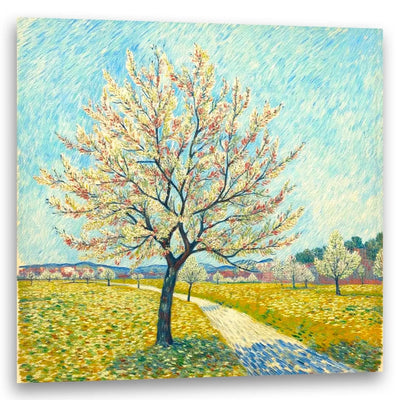
At KUNSTWERK BILDER, we follow a clear principle: we draw inspiration from the great masters of art history — not to copy them, but to use their techniques, compositions, and genius for contemporary art.
The old masters perfected lighting, revolutionized perspective, and created color harmonies that still resonate today. These technical and aesthetic achievements are timeless. But the world has changed — and art must reflect that.
That is why we take the principles of the masters and develop them further: we use their compositional techniques for new motifs, their color palettes for current themes, and their visual language for modern narratives. The result is art that is technically grounded while speaking in a contemporary voice.
That means Respect for the original — no cheap reproductions, no mutilated cropped sections, no hollow copies. Instead: a deliberate evolution that honors the masters' genius and makes it useful for today.
This approach sets us apart from mass-produced goods: our images have an art-historical foundation, a carefully considered composition, and a clear artistic intention. They are not arbitrary, but intentionally designed — with the knowledge and technique that centuries of art history have produced.
Why the difference between mass-produced goods and sophisticated art is noticeable in everyday life
The difference between a generic wall picture and a thoughtfully created work of art does not show up on a checklist, but in everyday experience. An image built on art-historical principles changes with the light, with the time of day, with your own mood. It gives something back.
Mass-produced goods, by contrast, remain silent. They fill a surface, but they do not speak. No composition that guides the eye. No color harmony that connects with the room. No layer that reveals something new on a second or third look.
Anyone who has once had a picture on the wall that truly works — one that changes the room, sparks conversation, looks different in the morning than in the evening — notices the difference. Not intellectually, but physically. The room feels different.
That is exactly the point: good art does not work with trends or marketing promises, but with composition, color, form. With what the masters developed centuries ago and what works just as well today as it did back then.
Art that shapes rather than decorates
Art in living spaces should be more than a decorative accessory. Psychologically speaking, it fulfills core needs: identity, mood, stimulation, and spatial definition. The flood of cheaply produced wall art may offer apparent quick fixes, but it often fades without effect.
Sophisticated art — inspired by the masters, but developed in a contemporary way — challenges us, enriches spaces, and stays memorable. At KUNSTWERK BILDER, we combine the genius of the great masters with modern motifs and themes. The result is images that are technically grounded, aesthetically well thought out, and relevant in content.
With high-quality prints, sophisticated art can be brought into any living space at fair prices — art that does not just decorate, but shapes.


 ""}"
loading="lazy" width="1600" height="1600" />
""}"
loading="lazy" width="1600" height="1600" />
 ""}"
loading="lazy" width="1600" height="1600" />
""}"
loading="lazy" width="1600" height="1600" />
 ""}"
loading="lazy" width="1600" height="1600" />
""}"
loading="lazy" width="1600" height="1600" />
 ""}"
loading="lazy" width="1600" height="1600" />
""}"
loading="lazy" width="1600" height="1600" />
 ""}"
loading="lazy" width="1600" height="1600" />
""}"
loading="lazy" width="1600" height="1600" />
 ""}"
loading="lazy" width="1600" height="1600" />
""}"
loading="lazy" width="1600" height="1600" />
 ""}"
loading="lazy" width="1600" height="1600" />
""}"
loading="lazy" width="1600" height="1600" />
 ""}"
loading="lazy" width="1600" height="1600" />
""}"
loading="lazy" width="1600" height="1600" />
 ""}"
loading="lazy" width="1600" height="1600" />
""}"
loading="lazy" width="1600" height="1600" />
 ""}"
loading="lazy" width="1600" height="1600" />
""}"
loading="lazy" width="1600" height="1600" />
 ""}"
loading="lazy" width="1600" height="1600" />
""}"
loading="lazy" width="1600" height="1600" />
 ""}"
loading="lazy" width="1600" height="1600" />
""}"
loading="lazy" width="1600" height="1600" />
 ""}"
loading="lazy" width="1600" height="1600" />
""}"
loading="lazy" width="1600" height="1600" />
 ""}"
loading="lazy" width="1600" height="1600" />
""}"
loading="lazy" width="1600" height="1600" />
 ""}"
loading="lazy" width="1600" height="1600" />
""}"
loading="lazy" width="1600" height="1600" />
 ""}"
loading="lazy" width="1600" height="1600" />
""}"
loading="lazy" width="1600" height="1600" />
 ""}"
loading="lazy" width="1600" height="1600" />
""}"
loading="lazy" width="1600" height="1600" />
 ""}"
loading="lazy" width="1600" height="1600" />
""}"
loading="lazy" width="1600" height="1600" />
 ""}"
loading="lazy" width="1600" height="1600" />
""}"
loading="lazy" width="1600" height="1600" />
 ""}"
loading="lazy" width="2100" height="2100" />
""}"
loading="lazy" width="2100" height="2100" />
 ""}"
loading="lazy" width="1500" height="2100" />
""}"
loading="lazy" width="1500" height="2100" />
 ""}"
loading="lazy" width="1500" height="2100" />
""}"
loading="lazy" width="1500" height="2100" />
 ""}"
loading="lazy" width="2000" height="2000" />
""}"
loading="lazy" width="2000" height="2000" />